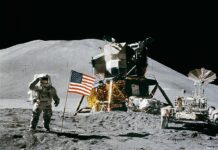
When Apollo 17 lifted off on December 7, 1972, NASA was closing the door on one of the most ambitious chapters in human history. It would be the sixth and final mission to land astronauts on the lunar surface, marking the end of the Apollo program’s extraordinary Moon era. What unfolded over the next twelve days was a blend of science, exploration and profound symbolism — a mission designed not just to reach the Moon, but to understand it deeply.

The Crew That Made History
Apollo 17 was commanded by Eugene A. Cernan, a veteran astronaut who had flown on Gemini 9 and Apollo 10. Joining him were two more pioneers:
- Harrison H. “Jack” Schmitt – Lunar Module Pilot
Schmitt was the first trained geologist to walk on the Moon, selected specifically to maximize scientific return from the mission. - Ronald E. Evans – Command Module Pilot
Evans remained in lunar orbit aboard the Command Module America, conducting experiments and photographing the Moon’s surface.

Their combined experience, field training and scientific expertise made Apollo 17 one of the most sophisticated lunar missions ever conducted.
Destination: Taurus–Littrow Valley
Unlike previous missions, Apollo 17 targeted a site chosen primarily for its geological richness. The Taurus–Littrow valley promised a mixture of ancient highland material and younger volcanic deposits — a unique opportunity to sample the Moon’s deep past.

The rugged landscape, framed by the towering South Massif and North Massif, gave scientists access to terrain untouched for billions of years. The astronauts would spend their time investigating these formations, searching for clues about the Moon’s evolution.
Landing and First Steps
On December 11, 1972, the Lunar Module Challenger touched down on the Moon. As Gene Cernan stepped onto the surface, he echoed the humility and ambition of the entire program:
“We leave as we came, and, God willing, as we shall return — with peace and hope for all mankind.”

These words would become symbolic of Apollo’s legacy and humanity’s aspirations beyond Earth.
Three EVAs and a Mountain of Science

Apollo 17 included three long moonwalks, totaling about 22 hours outside the lander — the most surface time of any Apollo mission. With the Lunar Roving Vehicle, Cernan and Schmitt traveled more than 30 kilometers across the valley.
Their work included:
- Sampling ancient highland boulders at the base of the South Massif
- Examining volcanic glass beads that hinted at past lunar eruptions
- Deploying scientific instruments to measure seismic activity, heat flow and the Moon’s atmospheric properties
- Conducting deep drilling to study the lunar subsurface
Perhaps most iconic is the photograph of Schmitt standing beside Tracy’s Rock, deeply immersed in geological study — a testament to the mission’s scientific purpose.
Apollo 17 ultimately returned over 110 kilograms of lunar rock and soil, the largest collection from any single mission.
Ron Evans: Science From Orbit

While Cernan and Schmitt explored the surface, Ron Evans conducted extensive orbital science. He operated cameras and sensors to map the lunar surface in high detail, capturing images used for decades of research. During the return trip, Evans even performed a deep-space EVA to retrieve film canisters — one of the most unique spacewalks in history.
Return to Earth
After three days on the surface, Challenger lifted off and reunited with the Command Module America. On December 19, 1972, the crew splashed down in the Pacific Ocean.

With that, Apollo 17 closed the door on the Apollo program — but opened countless scientific pathways that still guide lunar research today.
Legacy of Apollo 17
Apollo 17 remains a symbol of what humanity can achieve when engineering, science and courage converge. Its legacy includes:
- The longest crewed lunar mission
- The most extensive scientific work on the Moon
- The first scientist-astronaut to explore another world
- The last human steps on the lunar surface to date

Most importantly, Apollo 17 left a message: we have the ability to return, explore deeper, and push further.
As NASA’s Artemis program prepares to send astronauts back to the Moon, Apollo 17 stands as a reminder of both how far we’ve come — and how far we’re destined to go.