Apollo 15, launched on July 26, 1971, marked a major turning point in NASA’s lunar program. It was the first of the advanced “J missions” — longer stays, more science, more mobility, and deeper exploration of the Moon than ever attempted before.

With Apollo 15, humanity didn’t just visit the Moon. It began to explore it.
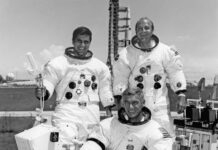
The Crew of Apollo 15

The mission was led by three highly skilled astronauts:
- David R. Scott — Commander
- James B. Irwin — Lunar Module Pilot
- Alfred M. Worden — Command Module Pilot
Scott and Irwin would perform extensive geological work on the lunar surface, while Worden conducted orbital science from above.
Each crew member played a crucial role in transforming Apollo 15 into one of the most scientifically significant missions in NASA history.
Training for a New Level of Exploration

Because Apollo 15 placed heavy emphasis on science and geology, the crew underwent months of advanced field training in locations such as Hawaii, Iceland, Arizona and New Mexico.
Commander David Scott, photographed during training in Hawaii, dedicated himself to mastering geology so he could interpret the Moon’s landscape like a professional scientist. This preparation shaped the mission’s extraordinary results.
Landing at Hadley–Apennine: The Most Beautiful Site of Apollo

Apollo 15 touched down on July 30, 1971, in the Hadley–Apennine region — often considered the most stunning landing site of the Apollo program.
The landscape featured towering mountains, deep canyons and the winding Hadley Rille, a massive volcanic channel. This terrain offered unmatched scientific value, especially for studying the Moon’s volcanic and tectonic history.
Introducing the Lunar Roving Vehicle (LRV)

Apollo 15 debuted a revolutionary tool: the Lunar Roving Vehicle — the Moon’s first car.
This lightweight, electric rover allowed Scott and Irwin to travel much farther from the Lunar Module than previous crews, covering more than 27 kilometers across three moonwalks.
The rover transformed lunar exploration, enabling astronauts to reach slopes, craters and geological formations that were previously out of range.
Three EVAs and Breakthrough Discoveries
Apollo 15’s surface activities were groundbreaking..

Major accomplishments included:
- Collecting the legendary Genesis Rock, a piece of the Moon’s early crust
- Exploring Hadley Rille from its edge
- Conducting detailed geological surveys
- Demonstrating Galileo’s theory by dropping a hammer and feather simultaneously
- Deploying scientific instruments to record lunar seismic and environmental data
Scott and Irwin spent more than 18 hours outside the Lunar Module — some of the most scientifically productive hours in lunar history.
Al Worden’s Science in Orbit — and His Historic Deep-Space EVA

While Scott and Irwin worked on the surface, Alfred Worden conducted orbital experiments aboard the Command Module Endeavour.
He mapped the Moon, measured its magnetic fields, and used powerful cameras to study the terrain below. On the return trip to Earth, Worden performed the first deep-space spacewalk, retrieving film canisters from the service module’s scientific instrument bay — over 300,000 kilometers from home.
It remains one of the most extraordinary EVAs ever performed.
The Journey Home

Apollo 15 splashed down in the Pacific Ocean on August 7, 1971, successfully completing a mission that redefined what lunar exploration could achieve. The crew was recovered by the USS Okinawa, bringing home new knowledge, new technology, and samples that would transform lunar science.
The Lasting Legacy of Apollo 15

Apollo 15 represents a new frontier in human exploration:
- The first mission with the Lunar Rover
- The most advanced geological fieldwork ever conducted on the Moon
- One of the greatest sample returns of the Apollo era
- The first deep-space EVA
- A mission that expanded both the reach and the purpose of lunar exploration
Apollo 15 demonstrated that humans could not only visit another world, but explore it in depth — a legacy that continues to shape future missions to the Moon and beyond.