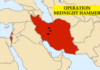

In a dramatic overnight escalation, the United States launched a massive airstrike campaign targeting Iran’s most fortified nuclear facilities. The operation, codenamed “Midnight Hammer,” involved B-2 Spirit stealth bombers and submarine-launched cruise missiles in a coordinated strike that U.S. officials described as “a historic and overwhelming success.”
Strategic Targets Hit
The U.S. Department of Defense confirmed that key nuclear sites—including Fordow, Natanz, and Isfahan—were struck with high-precision bunker-busting bombs. These sites, buried deep underground and protected by heavy fortifications, were believed to be central to Iran’s uranium enrichment and weapons development programs.
Gen. Dan Caine, Chairman of the Joint Chiefs, said:
“These were the most complex and precise airstrikes we’ve conducted in decades. Our mission was to destroy, not delay, Iran’s nuclear capabilities.”
B-2 Bombers and Tomahawks Lead the Strike
- Seven B-2 bombers departed from Whiteman Air Force Base in Missouri.
- They dropped GBU-57 “Massive Ordnance Penetrator” bombs designed to penetrate hardened targets.
- U.S. Navy submarines in the Persian Gulf and Red Sea launched Tomahawk cruise missiles in parallel.
- Over 125 aircraft and 75 precision-guided munitions were involved—making it one of the largest U.S. strategic airstrikes in decades.
Result: Iran’s Nuclear Infrastructure Crippled
Satellite images and local Iranian reports confirm massive destruction at:
- Fordow, buried under a mountain, heavily damaged.
- Natanz, central to uranium enrichment, engulfed in smoke.
- Isfahan, a known heavy water facility, reportedly struck by multiple waves.
White House: “Mission Accomplished”
President Donald Trump addressed the nation hours after the strike:
“Iran’s nuclear dreams have been obliterated tonight. This was a spectacular military success and a message to all rogue regimes—we will act when our security is threatened.”
Iran Vows Retaliation
Iranian officials called the operation an act of war, and Foreign Minister Abbas Araghchi warned of “grave consequences.” No details of a military response have yet emerged, but Iran has activated its missile and air defense networks across major cities.
State media described the strikes as “criminal and unjustified,” calling on the international community to condemn U.S. aggression.
Global Reactions
- UK, Germany, France: Expressed concern, urged restraint.
- Russia and China: Strongly condemned the strikes, accusing the U.S. of violating international law.
- Israel and Saudi Arabia: Reportedly briefed before the operation and expressed support.
- United Nations: An emergency Security Council session is scheduled within 24 hours.
Oil Prices Surge, Regional Tensions High
Following the strike:
- Oil prices jumped 12%, amid fears of disruption in the Strait of Hormuz.
- U.S. military bases in Iraq, Syria, and Qatar have been placed on high alert.
- Shipping firms rerouted tankers as tensions rise in the Gulf.
What’s Next?
The full ramifications of this strike are still unfolding. Key developments to watch:
- Iran’s military response – via missiles or proxy groups.
- Diplomatic fallout – especially from Europe, China, and Gulf countries.
- Global market reaction – especially energy and defense sectors.
Expert Analysis
Dr. Leila Mahdavi, a Middle East security analyst, notes:
“This wasn’t just a warning shot—it was a strategic decapitation of Iran’s nuclear capabilities. But it comes at the cost of dramatically raising the risk of open war.”